appliance repair parts help home banner

Search Site Content

Share

How Washing Machines Work

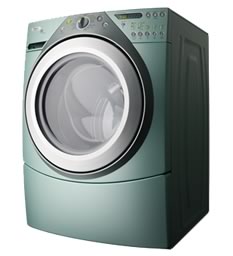
whirlpool duet washer

Todays Washing Machines Come In Two Main Mechanical Styles, "Top Loading" and "Front Loading" Also Called "Horizontal Access". The Idea is Similar but Obviously Some Differences Exist. The Following Is an Overview of How Washing Machines Work. Click Links Within the Page for More Detailed Information, Troubleshooting, and Help!

Design variations of washing machines differ by manufacturer, but the general principles are essentially the same, and can be divided into two halves, the washer's control system and the washer's mechanical system. The washer control system consists of the timer, control boards, load size selector (pressure switch), a water temperature selector, lid switch. The mechanical system includes the motor, transmission, clutch, inner and outer wash tubs, suspension system, agitator, pumps, water valve, and a belt or motor coupling.

Washing machines clean clothing by forcing a water and detergent mixture through fabrics. The action of forcing detergent infused water through your clothing fabric is what enables the detergent to chemically loosen dirt embedded in the cloth and separate it from the fabric. Count your blessings; in the old days, people would beat wet clothes against a rock loosen dirt!

In top loading washing machines the agitator ratchets back and forth dragging clothing down to the bottom of the washer tub. The clothes then move back to the top where the agitator grabs them again. In a front-loading washing machine, the clothes tumble through water in the base of the washer tub over and over again. After the water is pumped out, the inner drum uses centrifugal force to squeeze water from fabrics and clothes by spinning between 500 to 1200 RPM (revolutions per minute.) depending on the washer model.


Washer Repair PDF Manuals

Calypso Washer Technical Manual
Duet Washer Technical Manual
Direct Drive Washer Manual

Tub

All washers have two tubs. The inner tub contains your clothing and has lots of holes in it allowing water to pass through freely to the outer tub, which actually contains the water. During the spin portion of the cycle the inner tub spins around 500 RPM (Revolutions Per Minute) in a top-loading washing machines, while Front-loading and energy saving washers spin much faster at about 1000 RPM. This squeezes the majority of water out of your clothing greatly reducing drying time.  The drain pump then removes dirty wash water from the outer tub. Slightly more efficient and convenient that a wringer!


While this is a big improvement over a washboard it was
also considerably more dangerous. That loose sleeve
could cost you an arm.
Suspension System

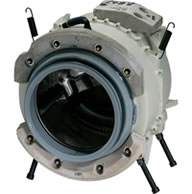
washer tub and suspensionModern washing machines use a suspension system of springs, slide plates, and load bearing pads to keep the wash tub in the correct position and control the forces required for spinning and stopping the inner tub, as well as reduce the amount of noise associated with washer mechanics.

(Watch the washer repair video)


Timer

A washer’s timer is the brain behind all of the washing machines functions.  The timer has many small contact switches that open and close as they are activated by a rotating cam, similar to a music box or player piano. As the switches close different components within the washer are energized so they can perform their work at the proper time.  The timer is usually the first thing blamed for a malfunctioning washer; however, it is rarely the cause.  Timers may fail in the following ways.  The timer motor doesn’t rotate the internal cam, some of the switch contacts weld closed and never open, or some of the switch contacts build up carbon deposits and fail to close and make contact, not allowing a particular washer component to receive the electricity needed to work.  If you look closely at the washer timer in the picture above the third contact from the right is blackened from electrical arcing. Do Not open your washing machine’s timer for a peek they can rarely be reused after being opened.  Washer timer problems must be diagnosed by symptoms and voltage checks with a voltmeter.

(Watch the washer repair video)

Back to top

Control Boards

Some washing machines use control boards instead of a timer for more accurate control of the washer’s functions.  The purpose of a control board is basically the same as a timer; energize washing machine components at the proper time.  To do this the control board monitors sensors throughout the washing machine to regulate water temperature, wash and spin speeds, fill and drain time as well as user commands.  Washing machine control boards are computerized and slightly more difficult to diagnose, and expensive to replace. Fortunately most washers that are control board operated, such as the Whirlpool Duet & Cabrio, Maytag Bravo, and Sears Kenmore Oasis have diagnostic modes that can be used to identify and fix washer problems.

Lid Switch

A washing machine's lid switch indicates whether the lid is open or closed, and will interrupt some or all of the washing machine operations.  This is a safety mechanism that has greatly reduced the volume of appliance related injuries.  A washer's timer will generally allow the washer to fill with water while the lid is open; however, most new washers will not allow any mechanical functions while the lid switch is open. Some older models will allow agitation, but no washing machines should spin with the lid open or a broken lid switch. The lid switch is the most common cause for a washer that won't spin, and some newer washing machines that will fill but not agitate. 

(Watch the washer repair video)

Water Valve

All washing machines have an internal water valve that connects to the water supply of your home and automatically controls hot and cold water to flow into the tub by opening an internal gate with several electromagnetic solenoids, also called “coils”.  There is one solenoid responsible for the hot side of the water valve and one for the cold side.  Some washing machines that have additional dispensers may have additional solenoids to control water flow to the fabric softener, bleach, or detergent cups. Over time the water valve screens can clog up with all kinds of debris and reduce the water volume able to flow through the valve into the washer’s tub.  This can cause the washing machine to take a very long time to fill up with water.  Some times the valve may fail to close completely and cause water to dribble into the washer’s tub when it should not. .

(Watch the washer repair video)

Back to top

More

www.repairclinic.com